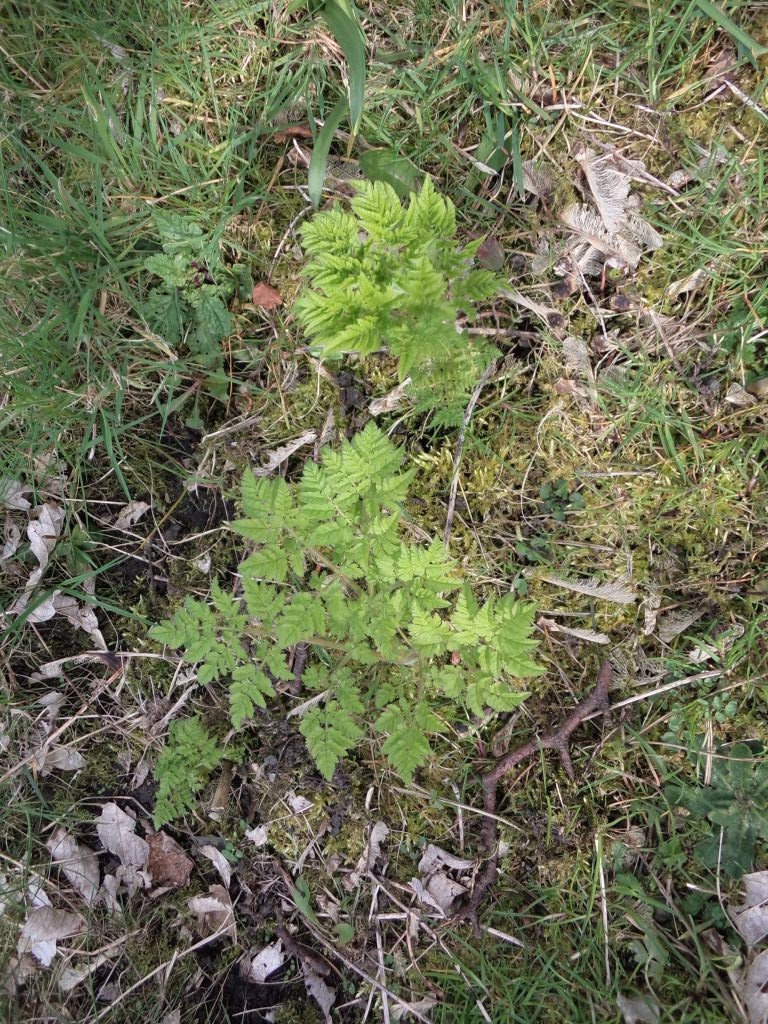
April is the most confusing month. Sunshine and showers make it difficult to know what clothes to wear. Usually it has Easter in it, but not always because it is something to do with the moon or something - I don't know. This year there are people going around asking me to make up my mind on this and that and I don't know what this is never mind what that is. And even in my garden at this time of year I have things growing which I am unsure whether or not I want to be growing here, which throws up the eternal philosophical dilemma: to weed or not to weed.
For instance, like nature, I don't really like bare soil but do I want everything that is growing in this corner under the sycamore?
Is it getting over-crowded?
Can the soil sustain all these plants?
Is the mix of species too much?
Should I enjoy the glut because come the end of June when the canopy puts it in full shade this patch may look very dull indeed?
What should I do with those seedlings or plants I don't want?
Oddly, this spontaneous diversity in the tightly restricted environment of a container worries me less. Instead, I am intrigued to see what my layer of garden compost may throw up.
Already I think I recognise Veronica, Poppies, Forget-me-nots, Herb Robert, and maybe some Bittercress.
Lovely, though some of those even I might call a weed. So, should I weed?
In my back grass it is dead simple - I don't weed and so I get wonderful surprises such as this little Primula vulgaris which has seeded itself
On the other hand, while I love Bluebells and look forward to them blooming if I don't control them they could take over and smother out everything else . . .
. . . such as the Sweet Cicely trying to establish itself or . . .
. . . the magical Snake's Head Fritillary which seems to like the damp grassland I have at this spot.
I am guessing there are places in the world where people consider species daffodils weeds (Narcissus lobularisin this instance) - though I doubt it really.
It is that last thought that makes me realise there are no weeds in my garden. I use no herbicide but I have no weeds.
Only the extremist thugs like Bindweed, Japanese Knotweed and Ground Elder are unwelcome here. Otherwise, my only dilemma is what to do with what arrives or comes up.
So instead of looking down on the plants that surround me and getting confused as to what to do, I can relax, lie down and look up to see the light shining through.
Having said all that, I still don't know what to think about this and especially not that.
Spring is a time for looking forward, so I have decided to look back. As I wandered round my little garden today I found every pot I looked at was telling me a story: a story of times past.
This little piece of Rosemary (Rosmarinus officinalis) has grown from a cutting taken from a cutting taken from a Rosemary plant that my late wife Sue bought back in the year 2000 from Fairley's Garden Centre in Cairneyhill Fife.
It started off growing in a pot at our front door in Townhill, then became part of our award winning garden in Dunnikier Road, went with us to the hell that was Sauchenbush, and its genetic clone is just coming into flower in my haven of a back garden now.
The other cutting is a luxuriant cubic metre shrub in the ground and two more cuttings from it have recently rooted and have just been potted up on the kitchen window sill.
A sprig accompanied me to my mum's funeral in 2014. Yes, this Rosemary is full of memories for me.
Not quite as old this Sedum spurium was growing on the edge of a raised bed at Dunnikier Road back in 2004. Cuttings from it have been sold at car boot sales and church sales and some went to a good friend in Glasgow. It has suffered from neglect in the ground and in pots yet has kept on living.
It needs some care now I think, but I am frightened that if I molly cuddle it I might kill it!
This Sedum throws up dilemmas for me.
Trust me, this is the Plantain Lily: Hosta 'Sharmon'. This was one of three small plants that came to us in our first ever mail order purchase back in 2005. It was very exciting to get a living plant in the post! One didn't make it, one got left in Sauchenbush and one came with me here in 2012. I divided it last year and so I have three plants once again. This is the largest section - honestly.
Hostas like a bit of shade but I think I better remove the Sycamore seeds from the surface of this pot before they germinate.
The Bay Tree (Laurus nobilis) I bought in Spring 2004, and in my diary I wrote that I planned to train it over the next ten years into a beautiful standard specimen.
Ha! Well it is more of a fan than a lollipop these days. It has had a varied life in various pots, has sometimes flowered, has sometimes been turning yellow, has sometimes had little beasties curling up the leaves to make nests. In its early years we would bring it into the kitchen if a storm was forecast as we were told it does not like wind. This winter, partly because of the narrow bottomed pot and the fan, it has spent a lot of time lying on the ground - seemed safer than continually standing it up just to get blown down again.
One summer when my uncle became obsessed with cauliflower its leaves were quite successful in reducing the stench of boiled brassica around his house.
This year the Bay Tree deserves some love and affection too - and a new pot that won't blow over.
The trough has been around since Townhill too and used to be an alpine gem. Just now it consists of three plants: grape hyacinth; alpine lady's mantle and a red campion that seems to have decided to take up residence here.
The blue flowered Grape Hyacinth is Muscari azureum. This is a paler less invasive species than the one commonly found in gardens and was bought by us at the Royal Caledonian Horticultural Society Spring Show at the Royal Botanic Garden Edinburgh in 2007. Does that make it Royal Blue?
The little lady's mantle looking very brown at the moment is Alchemilla alpina bought from the Strathkinnes Herbs stall at Kirkcaldy Farmer's Market in April 2008.
It is a gem of a little plant and it was a joy to see it growing wild in Glen Nevis in spring last year - a true alpine.
I know, I know - I need to do something with this trough, but it still doesn't feel like it is really my trough to mess around with - even after over seven years.
Meanwhile, Foxgloves (Digitalis purpurea) and I go back a long way. My first memory is as a child and dad stopping the car to warn a man who was picking them at the edge of a wood that they were poisonous. Maybe that should have frightened me but I was just in awe of those majestic plants that towered over me.
Dad still sees them as weeds, while for me they are still one of my favourite flowers. Amongst the first plants I bought there hasn't been a year since when I haven't raised a good many from seed or delighted in letting them sow themselves around where they will.
And if I am lucky, they can still sometimes be plants that I have to look up to.
I could go on but I won't, for these are my own memories and are probably of very little interest to anyone else. But just to prove I have not completely given up on the present here are some pictures of the Crocuses in flower in my garden today:
Crocus chrysanthus 'Flower Record'
Then under the Cherry Tree:
Crocus x cultorum 'Pickwick'
Under the Sycamore:
Crocus tommasinianus 'Barr's Purple'
Beside the Yew, Spiraea and Elder:
Crocus chrysanthus - assorted species.
And in a container in a picture determined to stay on its side is a load of yellow Crocus which were given to me a couple of years ago by a rather quirky work colleague and friend:
I haven't posted anything this year until now - mostly because life has been getting in the way of the back garden, which is rather odd as, for me, my back garden is where life is. Maybe one day I'll get back there, but in the meantime its memories will have to do.
The late gardener George Harrison was my favourite Beatle when I was a teenager: we almost shared a birthday; he was the "quiet one" and I was a "quiet one"; and in spite of believing it was all an illusion he also seemed to think life was worth noticing.
I don't know if life is an illusion but this year I am going to try and notice it more; and my back garden seems as good a place as any to begin.
An easy thing to notice is this Lenten Rose hybrid flowering earlier than usual. Indeed, it is one of only a few things in flower at this time. My garden is largely brown and bare - and thanks to that I actually notice things that I might not if it were all blooming.
For instance would I have noticed the small purple berries on the shrubby evergreen honeysuckle, Lonicera pileata? There may not be many, but they are there - though you may have to click on the picture to see them.
Would I have stopped to admire the bark on the Yew (Taxus baccata) stump that was so inexpertly cut by some predecessors of mine? Maybe it is their faces I imagine I see in the markings?
Even empty pots look good to me just now . . .
. . . including the ones that in the summer I bemoan as impractical because of their narrow bottoms have an appealing patina to me.
The Elaeagnus pungens is beginning to reward me for having summer-pruned the stems that had reverted to green.
In the grey air and brown ground I find an honest beauty in the plain green leaves of the Irish Ivy, Hedera hibernica.
And the longer I look the less plain they seem.
I can't help but notice what is going on in my little plastic greenhouse. This is Garlic which I planted in the autumn. This is from a bulb that came from France - from the garden of a good friend's sister. Some I ate, some I am growing - or rather, it is growing.
Patience is required before I'll notice much happening here - Dwarf Broad Bean 'The Sutton' sown in pots on the first day of this here new year.
Surviving all this rain, and my attendant neglect, are the seedlings of Ragged Robin (Lychnis flos-cuculi); Columbine (Aquilegia vulgaris) and Foxglove (Digitalis purpurea).
In the ground, even though it is trying to hide under the Bugle (Ajuga reptans) is an emerging shoot of the daffodil Narcissus 'Tresamble'.
Shoots are everywhere (slight exaggeration) - this is the common snowdrop Galanthus nivalis.
Over here, obviously of course, this is a completely different snowdrop: Galanthus elwesii.
Meanwhile, this may look like an unweeded patch to you but to me it is now and soon will clearly be:
These unpromising looking emerging leaves are actually friends of our native woodland plant, Lesser Celandine. This will have dark brown/purple rosettes of leaves beneath bright yellow flowers and is called Ranunculus ficaria 'Brazen Hussy'.
Back in the potting shed, looking through the reflections of the window, it is not always so clear what is going on. This unwatered, supposedly resting tender zonal geranium (Pelargonium) has decided to put out a pink flower in January.
So for me, this year the plan is to spend even more time than normal drinking tea in my back garden and try to notice what is going on all round me: to appreciate the moment and, well, be here now. I might even try it with life.
George Harrison, being a more experienced gardener and probably a better Beatle than I, can say it better than I can - so he can have the last words.
I started this blog in January as an antidote to depression and it would appear to have worked. And today, on my way home, I popped into that well known exclusive nursery, B&Q, and got some Broad Bean seeds for sowing tomorrow - the first day of the new year.
So, I guess that means when it comes to life in a back garden I am keeping on going anyway - which reminds me of yet another Abba song. May you have a Happy, Productive and Inspiring New Year. Peace, Love and Harmony.
Is meaning important? Is it important in this back garden? Or is how more relevant?
For instance, how does all this . . . .
, , , , become this?
And how does this . . . .
. . . . become this?
And then how does all that combined give us this?
Even in December it is still giving us this:
And this:
And this summer bedding plant Pot Marigold (Calendula officinalis):
Well, better-informed people than me can answer those questions for you - at least to a fairly large extent - so I won't give you my own half-remembered half-misremembered explanation. But what about the meaning of all this . . . and, indeed, that?
Why, for instance, did the wind blow down this part of the fence last week?
I can see the how is partly to do with the fact my neighbour did not maintain his side, but why this bit and not another?
And why did that same wind choose to blow these party balloons up into the the tree in my garden?
Some people tell me that December is winter time and yet this spring time Primrose (Primula vulgaris) has decided to come into bloom.
They tell me that December is winter time and certainly the frost has formed on the rosette of a Foxglove (Digitalis purpurea) - the same frost that will kill the rosettes of other less hardy plants.
And yet that same December winter can give light that makes the leaves glow on a supposedly deciduous shrub (Cornus - don't know the species).
Personally, I think he knows the meaning of all this but he is not telling - at least he is not telling me.
Or maybe he has the same problem as me. For I find that sometimes I think I do know the meaning of it all but as soon as I try to put it into words it is gone. So, I am left forever alone with whatever meaning I think I make of it all. And you know what? That suits me just fine - this December.