Monday, 6 July 2015

To Be A Flower, A Fruit Or A Seed?

To be a flower, a fruit or a seed?  That is the question.  Or at least I used to think that was the question.

To be a flower?  And if a flower, then what kind of flower?


Corn Poppy dropping its head in the rain: Papaver rhoeas.


Cobweb House Leek so called because of the apparent web on the foliage: Sempervivium arachnoideum 'Rubrum'.


What you may think is the flower here is not - the flowers are those tiny things in the middle - hundreds of them.  This is a form of Fleabane: Erigeron.


This flower is so torn it is actually called Ragged Robin: Lychnis flos-cuculi.  It has hitched a lift here in a pot of Red Campion - not entirely sure how as it usually likes damp places - maybe the drainage in this pot isn't up to much.


A single rose - Rosa - : single meaning it has only the one set of petals as opposed to the more common garden rose which has rows and rows of petals.  Bees like these while the other roses are pretty useless from their point of view.


This is what remains of the sumptuous and scented red Rosa 'Etoile d'Hollande' whose picture I posted back in June - has it been pollinated?  I'd be surprised really, but is that a fruit forming?


The spectacular trumpets of the Asiatic Lily - Lilium 'Blackout'.


The simple yet exquisite beauty of our native Meadow Cranesbill - Geranium pratense - flowering for the first time in this garden.


One of the first flowers whose form caught my imagination as an adult years ago when I knew even less than I do now, this is Fuchsia magellanica - delicate and exotic-looking but tough as old nails (although I have often found rusty old nails to be a bit fragile I assume the makers of traditional similes knew what they were doing).


Yellow florets of Hieracium pilosella while the first red flowers of the tuberous Begonia are appearing - the latter are in a container as I think it would be tricky to get these two plants to grow happily alongside each other in the ground.


More florets - this time the orange of Fox and Cubs - Pilosella aurantiaca - and of course, those grasses are in flower as is the Red Campion - Silene dioica.


Is this grass in flower or is it in seed?  I think it is both, maybe: Greater Quaking Grass - Briza maxima.


Urtica dioica - stinging nettle - just lets its flowers dangle while sending vigorous rhizomes underground - so does it really need the flowers?  Well they help sustain genetic diversity in the species thus improving its survivability - a good argument against racism as well, by the way.


Honeysuckle - in this case it is Lonicera periclymenum 'Graham Thomas'.


Some flowers look like they were made for bees - or were bees made for them?  A white Foxglove - Digitalis purpurea f. albiflora.  The answer, of course, is that they both evolved - but how?


The Maiden Pink - Dianthus deltoides - is the plant dominating this picture - called Pink not because of its colour but because of the pinking around the edge of its petals as if they had been trimmed with pinking shears.


And finally, florally speaking, a carpet of Creeping Red Thyme developing - Thymus coccineus, although I also have it listed as Thymus serpyllum 'Coccineus'.  So, which is the correct name?  I don't know, but either way don't let anyone steal it ....


To be a fruit?  And if a fruit, then what kind of fruit?


A Blueberry with fruits swollen waiting to turn purple - last year the blackbirds enjoyed these: Vaccinium corymbosum 'Patriot'.


But the Blackbirds aren't getting my strawberries - Fragaria - hence the netting.  They are slowly turning beautifully red and the botanists tell me they aren't really berries at all - but they are a fruit.


A flower that will be a fruit full of seeds: Bramble, or Blackberry - Ribes spp. - growing up through one of the Yew trees.
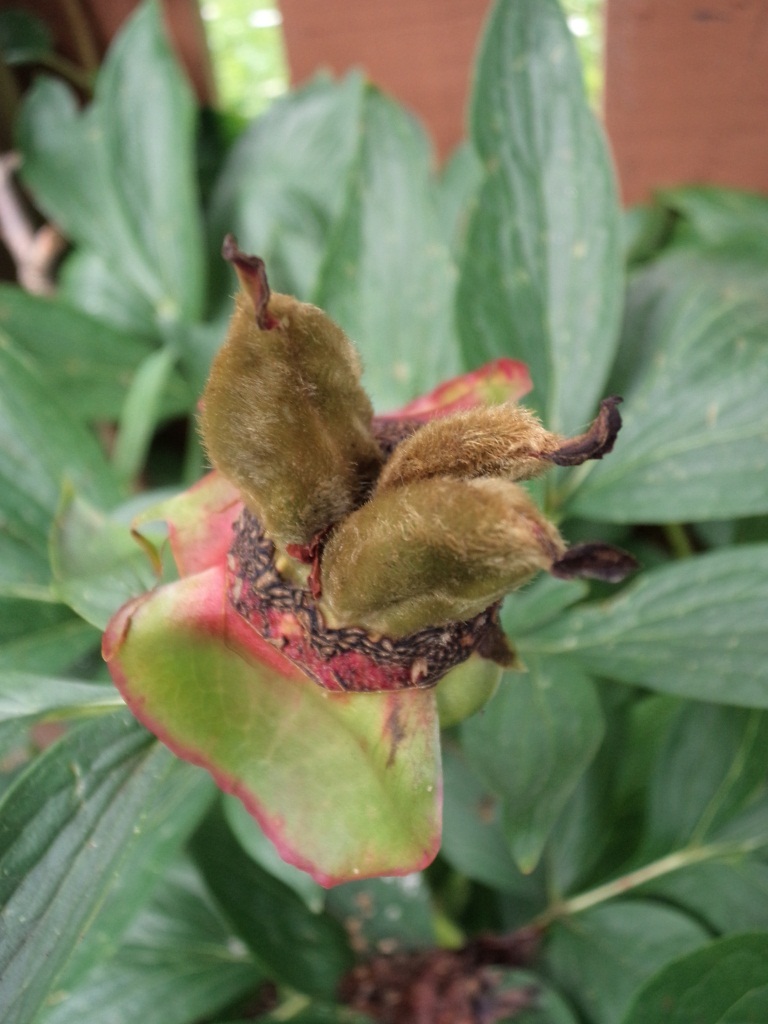


Fruit or seed?  Or both? Peony Rose, Paeonia, looks prehistoric to my eye and just a little bit scary.


To be a seed?  And if a seed, then what seed?


Seeds of the Snake's Head Fritillary - Fritillaria meleagris.  I collected these after taking this picture and will have a bash at growing some from seed - patience will be required.


On the plant you more often see the case that contains the seed (that would be a fruit, or a nut or whatever...).


Poppy - in this instance it is the orange Spanish Poppy- Papaver rupifragum.  Very pretty with its little windows at the top of the capsule through which the ripe seed will spill on a suitably windy day.


Poppy too and yet it manages to be both very different and very similar to the Spanish Poppy at the same time.  This is the Welsh Poppy (flower in the background) - Meconopsis cambrica.


Another little capsule full of seeds, this time on Red Campion - Silene dioica - no windows this time, just an open roof.


Some like  Columbine - Aquilegia vulgaris - make fancy little ships with their seed pods.  These belong to a huge family called Ranunculaceae and many of its members make a similar shape e.g Delphinium, Nigella and even Helleborus.  I'd show you if I could but the Delphiniums are still in flower - although I think I have a Hellebore.


Ach, too late - the seeds from this Hellebore or Lenten Rose - Helleborus orientalis hybrid  possibly - have long gone, but maybe you can still get a sense of what I mean.


Some seeds will just drop to the ground as they ripen: Windflower - Anemone blanda 'Blue Shades'.


While some seeds grow wings and fly - this is a cheat as this tree grows in my neighbour's garden but it largely overhangs mine so I feel I belong to it too.  It's a Maple - Acer - of some kind, but I don't know which.  Both flowers and seeds have a lovely crimson tinge and the leaves are clean of black spot unlike my Sycamore - Acer pseudoplatanus.


Honesty, Lunaria annua, has this attractive seedhead - the outer covering will peel off in time revealing the silver coins that I presume gave this its common name and certainly its generic name.


So which is to be? Flower, Fruit or Seed?  Well, I've decided it doesn't matter.  There's more to life than worrying about what stage I am at and while wise men can draw botanical distinctions in real life the boundaries are often very blurred - often it depends on your point of view.  They key for me is to try and savour whatever stage I am at and while looking at the detail is fascinating it is also good to keep my eye on the big pictures:


Of course, sometimes the big picture can look a mess but it's my mess and I am very grateful for it.


Saturday, 20 June 2015

You See Your Beauty

I wish I could write.  And when I say write I mean I wish I could really write.  For this evening I was sat on the swing and I was transfixed by an overwhelming sense of beauty.  It was made up of light and colour and plants and insects and movement and noise and yet it was so much more than all those things too.  Low light backlighting foxglove stems, creating an airy haze through Fennel, fresh Yew growth and London Pride flowers.  The air was alive with insects and gossamer webs were weaving from my neighbour's shed to plants in my garden.  To the foreground was a red Pelargonium in a pot and away in the distance was the dark red of the Peony.  Under the shade of the Sycamore the purple of the Alliums was fading almost to invisibility while splashes of the orange Spanish Poppy through it made me think that could have been deliberate, but it wasn't.  Bird sound was everywhere and I found myself thinking that maybe my late mum could see the beauty I can see in this garden now - I don't think she quite got it when she was alive.  Sue would certainly get it and see it.  And that is when I was struck by the thought - I actually helped create this.  I most certainly didn't do it myself and most of it was either done before I came or is caused by powers way beyond my control, but I did play some part in creating this moment of beauty.  And for a dumbass like me, that is a truly amazing thing.

As I say, I wish I could write because I'd like to share that moment more effectively with other people.  Or, I wish I could take photographs - I mean really take photographs - maybe then I could share the moment.  Or paint.  Or make a movie.

When I was younger I wanted to write because I thought I had something important to say about changing the world and if I wrote well enough then people couldn't help but be moved and the world would become a wonderful place.  Today I would like to write because I want to share just how beautiful life on this planet really is.

However, I am neither a great writer nor a great photographer so here are some pictures of some of the things in my garden that have given me a lift today.


I can start with a rose: Rosa 'Madame Alfred Carriere' which is a climbing rose.  I planted it in the winter of 2013 and have given it a good hole, mychorrizal fungi that supposedly help root establishment, and a load of manure in three springs.  This year it has rewarded me with a single flower that won't last long, but oh what a fantastic scent this bloom has.

Of course, the experts say this rose thrives on neglect - maybe I should listen to them.


A more subtle single bloom is Primula scotica - although there are more blooms to come.  This tiny flower is only found in Scotland.  I was inspired to grow it by Phil Lusby who was one of my tutors at the Royal Botanic Garden Edinburgh and who this summer was awarded the MBE by the Queen.

In particular it was Phil's book (written with Jenny Wright) that inspired me: "Scottish Wild Plants: Their History, Ecology and Conservation."

This is its third summer with me and not only is it alive but it appears to be increasing its number.  Thanks Phil.


I like this picture of the Hemerocallis I received from Peggy Nicholson and which is now in its first year actually in the ground.  I like it because it illustrates the reason for its common name, the Day Lily - each flower only lasts a day, but they keep coming.  You can see yesterday fading, today wide open, tomorrow preparing to open and the next few days budding.  Wonderfully, this will go on doing this through the summer.


Two more hardy geraniums have also begun to flower since my last blog entry:
Geranium pratense 'Mrs Kendall Clark'
Unknown Geranium that was here when I came.


Digitalis purpurea 'Primrose Carousel' is a new Foxglove for me which I grew from seed sown last year - it really is more yellow than this picture implies, but a lovely soft yellow rather than a loud one.


And almost as cherished as the Foxgloves are Delphiniums even though my garden is not ideal for them.  This one which is getting ready to open up soon is Delphinium hybridum ' Pacific Giant' which I grew from seed free with Amateur Gardening magazine.


And finally, we have the swing upon which I sit - complete with the Ox Eye Daisies which have begun to flower and which I hope will one day colonise much of this grassy area: Leucanthemum vulgaris.  I cheated with these by buying three small nursery grown plants last year - just to get me started.


As I sat on the swing another thought occurred to me: I don't need to write or photograph.  I've found beauty in my eyes.  And you, you will find beauty in your eyes - you don't need me to tell you that.  You just go out and find it.

I'll leave you with four old men singing a song - Long May You Run:


Saturday, 13 June 2015

Fuzzy Flowers

Being full of the cold I took some pictures of some flowers in the back garden and they all came out less sharp than usual: a bit like how I am seeing the world just now - everything is just a little hazy.


The first rose to bloom this year: Rosa 'Etoile de Hollande' : I planted this climbing rose as a bare root plant from Aberdeen in February 2013 and this year it has three blooms on it.

This is beautifully scented but my nose is bunged up.  C'est la vie, or should I say La Vie en Rose?


Spanish Poppy, Papaver rupifragum: this flowers for about a day but fresh flowers keep coming all through the summer if I keep dead-heading.


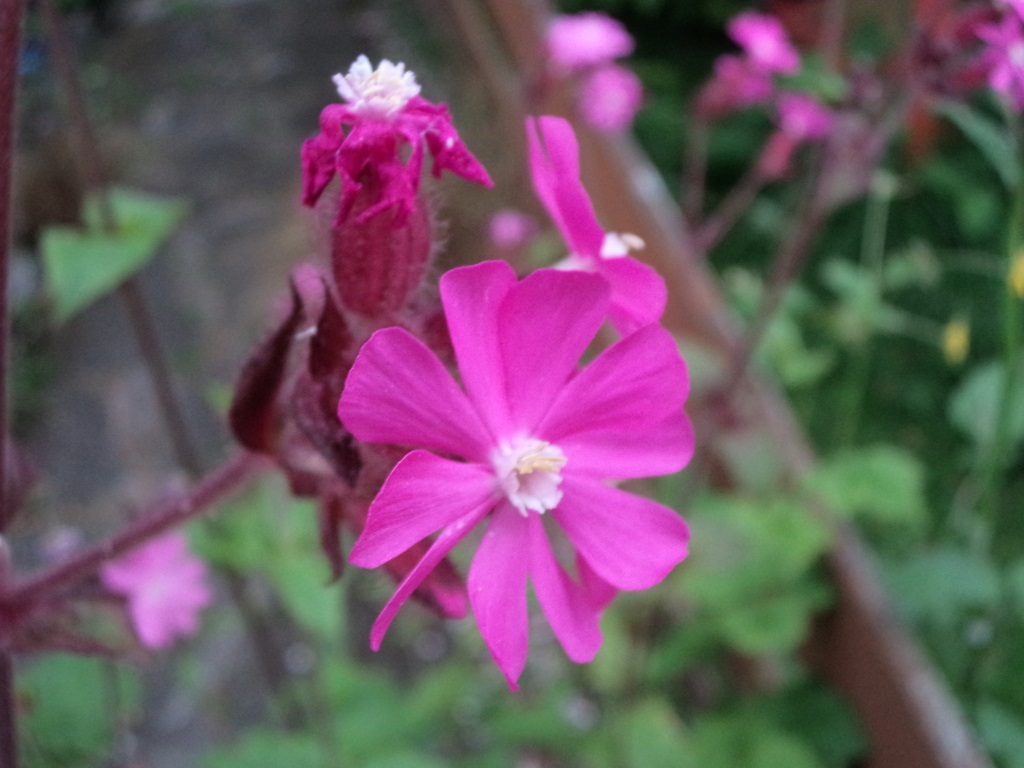
Red Campion, Silene dioica.  I'm not clear why I am in love with Red Campion, but I am.


Masterwort, Astrantia major.  I'm not clear why I am in love with Masterwort, but I am.


Honeybells, Nectaroscordum siculum, is a member of the onion family, Alliaceae.  Now in its second year in this garden.


I am also in love with white foxgloves - majestic, ghostly and so wonderful for bees - Digitalis purpurea 'Alba'.


The straight native foxglove is also a love of mine: Digitalis purpurea.

Indeed, I can't see myself ever having a garden without them.


Phacelia tanacetifolia is a plant often grown as a green manure. I sowed it in my first summer here and it has self-seeded itself since.  As well as feeding the soil this plant feeds the bees - so what is not to love?


One of the first geraniums to flower in my garden is Geranium nodosum. Is it me or is the plant that has changed since last year?  For although the flowers are small, I am loving it this year too.

Too much love? I can't seem to be able to help myself.


This really is hazy or fuzzy - isn't it?  This is Thalictrum aquilegifolium.


And now I am wearying - away to feel sorry for myself in my sick bed but I shall try and keep those hazy pictures of those flowers I love somewhere to the forefront of my mind.


Wednesday, 10 June 2015

Playing with Friends

Today I have been playing in the garden until 10pm - way past bath time, especially as it's a work day tomorrow.  Well, life is too short to waste time not playing.

I am always playing in my garden - usually on my own, but not really on my own as you shall see.


Thirst things thirst, on a scorching hot day like today has been, is to have a cup of tea in the mug given to me by a Secret Santa, resting on the stone minstrels given to me by Rudi and Maureen behind the London Pride given to me by Peggy.


And then it was off to play with the Bearded Iris given to me by Lorraine.  I planted the rhizome last year and it was about to give me one flower when the wind snapped the stem.

This year, however, it has given me about a dozen buds and is now revealing its amazing flower - the yellow beard on the lower petals (sepals) with their intricate markings all of which are formed to direct bees to the nectar at its heart so they will pick up the pollen and spread it to other flowers.

This is my first ever Bearded Iris and I love it.


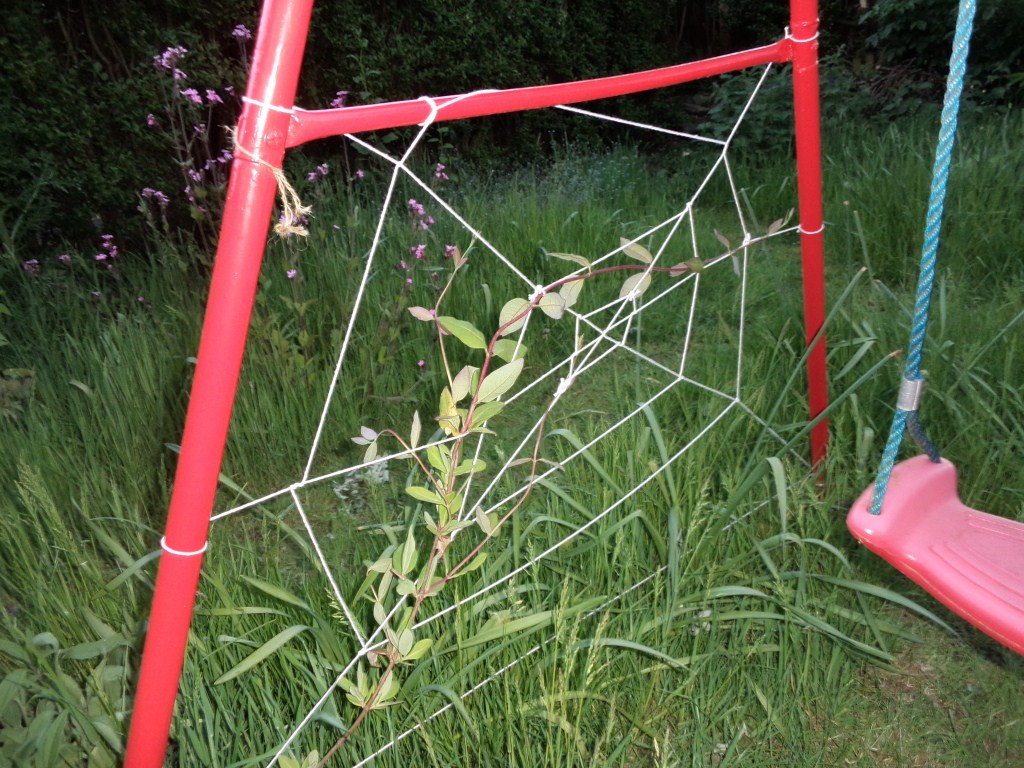
And then I made a spider's web on the swing for the Honeysuckle given to me by Peggy to grow through.  I have another one to make on the other side to hold the Ox Eye Daisies back from the path of the swing.


And then I prepared the strawberry bed for this year's harvest with straw to keep the fruit clean and netting to keep the birds off the fruit and ladybird clips and copper tags to keep the birds from getting tangled in the netting.

The strawberries were given to me by a friend of my dad's.

And, no I am not depriving the birds - there are odd plants dotted around the garden which are unprotected so we can all have a share.


And then I had to admire another Aquilegia which has just come into bloom.  This single elegant beauty is Aquilegia 'Mrs Scott Elliott' and was given to me by Lorraine too.


Of course, some things are given to me that I can't quite work out how to use.  The glass ball was a gift from me to my gran and auntie many many years ago and was given back to me by my auntie this year.

So far it is sitting by this complementary ball with a head of the Sedge Carex comans.

I am aware it is a potential death trap for creepy crawlies but it is safe for the moment I think.


Some gifts just seem to find a natural place - the badger given to me by mum seems to be emerging from its set while the Yew seems to have been cut back just to provide a perch for the owl given to me by Eleanor.


So, even when I am alone in my back garden I am never alone in my back garden: I am with friends and with family because of the gifts they have given me over the years.

And as the day draws to a close over Burntisland Binn and the mist begins to rise in the valley I remain  so grateful for all the days I have played in a back garden with my friends.


Thursday, 4 June 2015

The Joys of June

June was always my favourite month before I ever came to appreciate the other eleven.  I liked to walk the hills in June.  It's not too hot abroad in June.  I even got married in June.

And nowadays June seems to be the month I enjoy my garden the most.  There is both promise and fulfilment.  It begins with the days getting longer and it ends with the nights drawing in,  The slugs have not yet devastated the Hostas and the flowers have a subtlety that the later summer bloomers lack.  Can you see what I mean?


The blue Hosta sieboldiana - named after the German botanist Philipp Franz von Siebold who introduced the parents of most modern Hostas to Europe from Japan in the 19th Century.

(Additional trivia: the journal of the Royal Botanic Garden Edinburgh is also named in his honour)


Hosta 'Sharmon' - this particular plant is now ten years old, having survived two moves and seems to be rather happy in its current spot - the slugs will get it eventually though - but then their pooh enriches the earth so win-win really.


Hosta albomarginata 'Blue Mouse Ears' is a dwarf variety from Park Green Nurseries - it is only nine years old: just a baby.  Note the sycamore seed deliberately placed to give you a sense of scale.


Hosta 'So Sweet' is one whose flower gives off a sweet scent if grown in the sun - I, of course, have mine in the shade because I am logical that way.


This plant was originally growing in a pot in mum and dad's garden and came to us in the form of a cutting for my wife Sue's birthday in 2004.  It was our first Hosta!  I had no idea what variety it was until recently I identified it tentatively as Hosta 'Risky Business.'  The name seems apt on all kinds of levels.  It has had many a battle in life but it's still here and is flourishing.


However, June is not just about greenery.  This time of month is perfect for one of my other favourite plants: Aquilegia also known as Granny's Bonnets and Columbine.  Our first Aquilegia was a self-sown rosette in 2004.  We had just begun gardening and had no idea what this attractive foliage was growing in gravel in a corner,  We left it to see what would happen and the following year it put up a delightful purple flower which I now know to be Aquilegia vulgaris - the British native species.  I've since grown many from seed but in this garden, so far, I have grown primarily Biedermeier Mix.  Can a flower be subtle and showy at the same time?  I think so:


The Wild Flowers are beginning to look good now too:


A haze of Bluebells and Forget-Me-Nots: Hyacinthoides and Myosotis.

Unlike those in Glen Nevis I can't be sure mine are the British native H. non-scripta - in fact, almost certainly not.  But I didn't plant them - they were here when I came.


A pink and white haze this time created by London Pride - Saxifraga x urbium.
London Pride has been handed down to us,
London Pride is a flower that's free.
London Pride means our own dear town to us,
And our pride it forever will be.
Grey city,
Stubbornly implanted,
Taken so for granted
For a thousand years.
Stay, city,
Smokily enchanted,
Cradle of our memories,
Of our hopes and fears.

Written by Noel Coward during the London Blitz.


More virtue in the shape of Honesty - Lunaria annua.  When flowering is over this will form seedheads that turn silver and will later shine through the shortest of days.


If Saxifraga x urbium is London's Pride then Red Campion, Silene dioica, could easily be Fife's floral emblem for it seems to bloom on every roadside across the Kingdom.


Alchemilla alpina is a montane version of Lady's Mantle - I didn't grow this from seed but it is happily self-seeding in the trough and one year I shall transplant because I love the silver edged foliage:


The Sweet Cicely, Myrrhis odorata, I planted last year seems to be taking to its spot and I hope to see it spread.  This is a naturalised rather than native plant - introduced to me by my good friend Katie Croft who advised me of its sugar-alternative properties.  Me, I grow it primarily because I think it is beautiful.


One of my pure joys in this garden is the annual cascade of the Hawthorn, Crataegus monogyna.  I feel so privileged to have inherited a garden that contains this magnificent specimen - something I am unlikely to have witnessed had I had to grow one from seed.

This June has felt a bit too cold to be casting any clouts just yet, though.


There is, of course, still lots of promise in June too.


Some of that promise comes from plants I am raising.


Some of it comes from plants I have planted.


And is it just me who sees in the Scots Pine, Pinus sylvatica, the shape of a Christmas Tree complete with candles and baubles just waiting for a party to begin?  Have a Joyful June, wherever you are.